
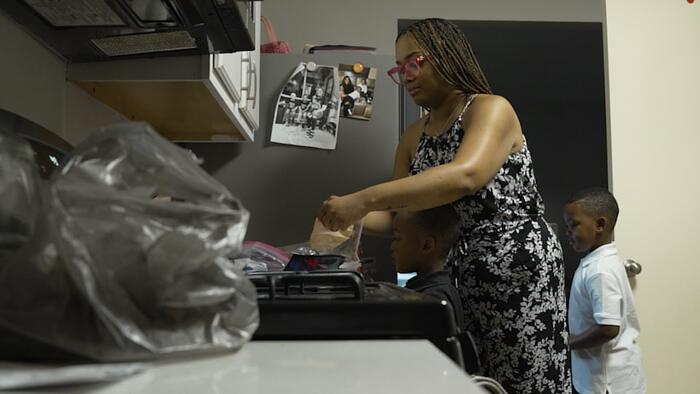
Brianna Ledet was excited when her two boys were approved for Texas Education Freedom Accounts – a program that gives taxpayer dollars to families to put towards their kids’ private and homeschool education.
With more than $10,000 in state funding to spend on each of her boys, Ledet was looking for a program that would work for her eldest and her youngest son, who was diagnosed with epilepsy and autism. She landed on St. Mary Magdalene Catholic School in Humble, TX.
Repeatedly, she described asking the staff at the catholic school if they would allow her youngest son’s registered behavior technician, or RBT, to work with him during the school day. The support services available, in her own words, were her main concern in choosing a school.
Records show the accommodation also was ultimately the reason the school cited when they administratively withdrew her son just a few weeks into the school year.
The change left Ledet hunting for a new TEFA-approved private school to avoid being among the more than 33,000 recipients who opted out of the state’s voucher-like program.

Days into the school year and the therapists joining Ledet’s son on campus, emails show the principal of St. Mary’s emailed her saying the Archdiocese of Galveston and Houston, which oversees the school, was temporarily pausing all outside therapy services on campus.
The email said the TEFA laws now required additional supervision and background checks. Her son’s therapists would not be allowed on campus until the process was completed.
The principal apologized in emails for not completing the screening process earlier.
In an email, the principal also reassured Ledet that her son was demonstrating that he could participate successfully in the classroom without a therapist present.
“I know my son. This is the honeymoon phase. If he is not with his proper support – you are not going to see the same kid,” Ledet said.
13 days into the school year, and now without his RBT, email records show that Ledet’s son was having issues, including an incident in which he ran out of class. Ledet said the school instructed her that her youngest son could not return to school without his therapist.
At the same time, emails show there was discussion between the diocese and the company providing her son’s therapy regarding the diocese’s requirements, including a request for a certificate of insurance stating that the service provider would be covered in the event of an accident while any of the therapists were on campus.
The company wrote, “We have therapists available and appropriately insured […] the current barrier to beginning services at school is resolving the additional contractual and insurance requirements required by the archdiocese as a condition of allowing our clinician on campus.”
The company told KPRC’s ENOUGH team that the requested provisions were more extensive than those it had encountered at other schools and daycare facilities, and that it was exploring ways to modify them to address the diocese’s concerns.
Two days later, records show, Ledet was notified the school was withdrawing her youngest son.
“I was taken aback,” Ledet said. “She told me, hey – we are just not able to agree. Basically, ABA is not going to do the requirements, and we are not going to lower the requirements, so he just can’t be here.”
A spokesperson for the Archdiocese of Galveston and Houston did not agree to an interview and said for confidentiality reasons they could not discuss any specific matters involving a student.
The diocese said it has nearly 4,000 TEFA students enrolled in its schools, and of those, more than 400 have been identified as having disabilities. The diocese spokesperson said it has longstanding insurance requirements for any outside vendors wishing to offer services on their campuses.
“The safety of each of our 13,500+ students is a high priority, and the archdiocese follows the same requirements for all our students, whether they are TEFA recipients or not, including students with accommodations,” Archdiocese of Galveston and Houston spokesperson Jonah Dycus said.
As lawmakers debated giving taxpayer dollars to private schools in March 2025, Disability Rights Texas Senior Policy Specialist Steven Aleman warned legislators about the potential issues voucher-like programs posed for students with disabilities.
“We’re all used to labels on that tell us what is in a product – what I am buying; where it is from. What we don’t have is labels on private schools that say very clearly, at this particular private school or campus, this is what we can do – this is what we have been doing,” Aleman said.
The special education notice on the TEFA website is on the families tab below the section on priority tiers and eligibility. It says a private school is not subject to federal and state laws regarding a child’s disability to the same extent as a school district or an open-enrollment charter.
Comptroller data show that students with disabilities make up more than 17 percent of students funded through the TEFA program. The data does not break down the types of disabilities among funded students or those who opted out.
After Ledet’s son was withdrawn from St. Mary Magdalene School, she was hunting again for a new private school for both of her boys. She and their father decided it was best to withdraw their eldest son too and find a place they could attend together.
She was also waiting for a refund of the tuition she had paid so she could pay tuition elsewhere. In an email, days after the withdrawal, a support specialist for the statewide program told Ledet her options were to “select another TEFA-approved school or opt out of the program.”
Ledet asked the specialist if her son would become ineligible for the program if she enrolled him in a public school while she searched for a new private school.
Records show the specialists told her she could not confirm exactly how that would apply to her son’s situation until the requirements for the next application period are released. Other resources on the TEFA website state “students who are found to be enrolled in a public or charter school during the school year shall be removed from the TEFA program.”
A spokesperson for TEFA confirmed its policy allows recipients who are switching schools mid-year to confirm enrollment at another TEFA-approved school within 30 calendar days. Families who do not confirm enrollment in that time frame would be opting out of the program.
“I tried to explain – he is only opting out because he was not able to have his placement that I planned for him to have, but they were still adamant about if you opt out you kind of forfeit your opportunity,” Ledet said.
The comptroller’s office, including the TEFA program it oversees, did not agree to an on-camera interview. A spokesperson for the Comptroller’s office told us they want to make sure students with disabilities can access a great education and “get all the support they need.”
The agency also said it doesn’t interfere with the decisions of schools, the Catholic diocese, or any school organization in terms of their decisions about who to employ.
The comptroller’s office, under the leadership of Don Huffines, released a transparency dashboard on the TEFA program in Oct. 2026. The dashboard shows that as of Oct. 29, more than 111,000 participants have money in their accounts, and more than 33,000 participants opted out of receiving the money – 13 percent of the eligible participants.
Data from the comptroller’s office also shows most of the participants who opted out of the program are either students with disabilities or the poorest qualifying students. Data obtained by KPRC’s ENOUGH team also show that a small portion of those students who received TEFA accounts have been withdrawn from their private schools – nearly 300 participants.

Texas State Sen. Paul Bettencourt, R-Houston, voted in favor of the bill that created Texas Education Freedom Accounts. Bettencourt said on the Senate floor in 2025 that a school choice program would sharpen the state’s education landscape – including public schools.
Bettencourt said the point of the program was to introduce competition. He now has questions about why thousands of families are opting out of the program.
“What are the reasons? Is it time? Is it geography? The school is too far away – they can’t get rides? Is it transportation?” Bettencourt asked.
The dashboard does not answer those questions. Bettencourt said he would be in favor of a survey that gets those answers.
“Look one of the reasons why I want to do a survey is because I want to know the answer. Because there are probably real answers there that need to be considered by policy makers,” Bettencourt said.
“There will be a chance for the public to come testify because I guarantee you, part of the people that will be testifying will be part of 33,878 that decided to give up the stipend.”
In January, Democrat Sarah Eckhardt will replace Don Huffines as comptroller. In a press conference, Eckhardt has already hinted at releasing more comprehensive data on who is funded under the TEFA program.
“I plan to have information that is routinely available that actually tells a story behind the numbers, that doesn’t just dump the numbers on people,” Eckhardt said.
Governor-elect Gina Hinojosa also promised in her victory speech to “repair” TEFA and push more money to public schools, while working to “do no harm” to families and kids already participating the program.
Ledet eventually found a new private school for both of her boys – one that was willing to wait for the refund of their TEFA funds. 21 days after the withdrawal, a TEFA specialist told Ledet that her refund had been approved and was being processed. A week later, records show the money was credited back to her TEFA portal.
The spokesperson said the program currently requires vendors to refund for services not rendered – including refunding partial tuition if a student doesn’t attend for the full time the entire quarter they paid for.
TEFA Assistant Director Travis Pillow told KPRC’s ENOUGH team that as of November, the program is processing refunds weekly. Pillow said nearly 600 refunds have been successfully processed, specifically returning funds back to students’ TEFA accounts.

“Yes, you can get the voucher. Yes, your child can get more because he is disabled. Yes, you can have those supports in place and it can still fall through. Make sure you are asking the appropriate questions for your child’s needs or your children’s needs – and see if they can truly accommodate it,” Ledet said.
“This situation could very well happen to another family.”


